Frequently asked questions
Who can make a submission?
Any interested individual or institution is invited to engage with the Royal Commission by making a submission.
What can submissions be about?
The content of submissions should be relevant to the Terms of Reference as set out in Annexure 1 of this guide. The online submission form requires authors to choose from the following categories:
- The nature and prevalence of antisemitism in institutions and society
- Key drivers of antisemitism in Australia
- Religious and ideologically motivated extremism and radicalisation
- Opportunities to enhance the responses of governments to antisemitism
- Best practice approaches to de-radicalisation and strengthening social cohesion
- Recommendations to counteract and prevent antisemitism
- The impact of antisemitism on the daily life of Jewish Australians, including but not limited to security arrangements, physical health, mental health and wellbeing
- The terrorist attack at Bondi on 14 December 2025
- Other
How do I make a submission?
The Royal Commission is using one online form for all submissions. Not all questions will be relevant to every person making a submission and only relevant questions need to be completed.
At present, the Royal Commission indicates they will be accepting submissions until 30 May 2026.
You can access the submission form on the Royal Commission website.
How will the Royal Commission use my submission?
All submissions received by the Royal Commission are safely recorded and reviewed. Every submission helps inform the Royal Commission’s work.
The Royal Commission may contact you about your submission, but it will not contact everyone who makes one.
The information you share will only be used for the work of the Royal Commission.
How public will my submission be?
The Royal Commission may publish some submissions, unless you ask for yours to be kept private. You can choose for your submission to be:
- Made public with your name,
- Made public without your name, or
- Kept private and not made public.
Even if you agree to publication, the Royal Commission may decide not to publish your submission, or may publish only parts of it. This can happen if the information:
- Is not relevant to the Terms of Reference,
- Is covered by a non‑publication order, or
- Raises concerns over privacy or fairness.
In some situations, the Royal Commission can use information without someone’s consent. It can share information with law enforcement agencies if it relates to an offence, or with another Royal Commission looking at related issues.
If you have any concerns about the sharing of your information, please contact our service for legal advice.
What will happen to my submission after the Royal Commission?
At the conclusion of the Royal Commission all its records, including submissions, will be stored with the Attorney General’s Department. Whilst there, records can be subject to requests under the Freedom of Information Act 1982 (the FOI Act). Any person has the right to apply for access to a document of an agency or an official document of a minister.
Royal Commissions are not subject to the FOI Act while they are in operation.
Tips on completing an online submission form
The online form can be accessed from the Royal Commission website.
The online submission form has three sections
- Questions about you
- Your submission
- Publication and use of submission
Section 1: Questions About You
You will be asked for your name and contact details. You can choose to stay anonymous by ticking the box. If you stay anonymous, the Royal Commission will not be able to contact you about your submission.
You will also be asked who the submission is for. If it relates to something you experienced with a family member, select ‘myself’. You do not need to make a separate submission for each family member.
Section 2: Your Submission
This is where you share your submission. You can type it directly into the form, or upload a PDF or Word document you have already prepared.
- Please note: the online form will close after 30 minutes if it is not used, and any unsaved information will be lost. To avoid this, you may wish to prepare your submission first, then upload it or copy and paste it into the form.
You will also be asked to choose which Terms of Reference your submission relates to. You can view the Terms of Reference on the Royal Commission website.
Section 3: Publication and Use of Your Submission
In this section, you can choose whether your submission can be made public and whether the Royal Commission can contact you.
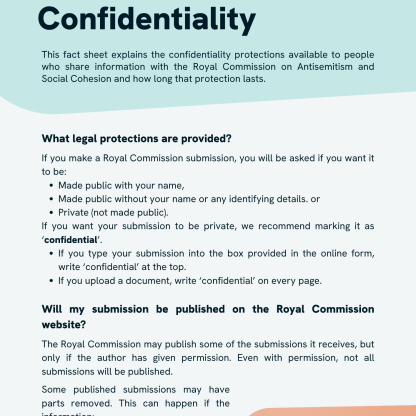
If you make a Royal Commission submission, you will be asked if you want it to be:
- Made public with your name,
- Made public without your name or any identifying details, or
- Private (not made public).
If you want your submission to be private, we recommend marking it as ‘confidential’.
- If you type your submission into the box provided in the online form, write ‘confidential’ at the top.
- If you upload a document, write ‘confidential’ on every page.
Guide to drafting your submission
There is no right or wrong way to write your submission. It is best to share what you experienced, using your own words.
You may want to describe what happened, as well as how it has affected you.
This might include impacts on your:
Wellbeing
Sense of safety
Sense of belonging within your local or broader community
Professional, educational opportunities or activities
Participation, affiliation or involvement with your community
Step 1: Introduction
Start by briefly explaining what your submission is about. Let the Royal Commission know if you are writing about your own experience, a shared experience, or someone else’s experience.
Try to restrict the information you provide to your personal experiences, or the experiences of those you are writing the submission on behalf of.
Step 2: Think about how you want to organise your submission
Before you start, think about what you want to share.
If your experience happened over a long time, it may help to write it in time order (chronological).
If you want to focus on particular issues, it may help to organise your submission by topic or by the Terms of Reference (available on the Royal Commission website).
Option 1: Writing in order of events (chronological)
- Think about the main events in your experience.
- Note any key dates or time periods. These can be used as headings.
- Under each heading, write what happened during that time.
- Share the facts as you remember them.
- Try to keep each section focused on that specific time or date.
- You can number your paragraphs if it helps.
- After describing the events, you may wish to add a separate section about how these experiences affected you overall.
- You can also share any thoughts or feelings you want the Royal Commission to understand and consider when making recommendations.
Option 2: Writing by topic or Terms of Reference
Choose the topic or topics you want to talk about.
You can then organise your submission under those topics or Terms of Reference. These can be accessed on the Royal Commission website.
Step 3: Share your ideas for change
You may want to include suggestions about how things could be better in the future under the heading ‘Recommendations’.
For example:
- What could have happened differently for you?
- Should there be stronger protections in place?
- Should there be independent oversight or an organisation to address concerns?
- What should change in the future?
- Could a new law or policy, or more funding, fix the problem?
Contact us
You can contact the Royal Commission Legal Assistance Service for free, independent and confidential legal advice.
An interpreter can be arranged upon request.
If you are hearing or speech impaired, you can contact us by calling the National Relay Service on 133 677 (TTY) or on 1300 555 727.
You can find more contact options, depending on your specific needs, on the National Relay Service website.