This page contains the Executive Summary and Summary of Recommendations sections from National Legal Aid's submission to the Department of Social Services' Consultation on the Second Action Plan (National Plan to End Violence against Women and Children 2022–2032). The submission is available in full for download below.
Executive Summary
NLA welcomes the opportunity to contribute to the development of the Second Action Plan under the National Plan to End Violence against Women and Children 2022–2032. Australia’s eight Legal Aids provide specialist legal assistance to victim-survivors, children, and families experiencing domestic, family, and gender-based violence across every state and territory.
Legal assistance is essential safety infrastructure. It converts legal rights into practical protection, helps victim-survivors make informed choices and gives children a safe way to be heard. Legal assistance helps people understand, obtain, test and enforce legal protection across multiple jurisdictions.
Family violence legal services are frontline, specialist services. A national family violence strategy that treats legal assistance as a referral option rather than frontline infrastructure will leave a critical implementation gap. The Second Action Plan is an opportunity to recognise legal assistance as an essential part of how Australia keeps women and children safe, and to fund it to meet the need.
Australia is facing a growing family law legal assistance crisis in the context of 86% of matters before the FCFCOA involving allegations of violence. Legal Aid services remain constrained by inadequate core funding to meet demand, short-term funding and an inability to provide ongoing legal representation when it is needed most. While the National Access to Justice Partnership (NAJP) 2025-30 delivered important investment for the legal assistance sector, it did not address the level of funding required. Legal Aids across Australia are now being forced to restrict services in response to increasing demand and rising costs. Eligibility for legal aid remains highly restrictive, with legal aid estimated to be accessible to only around 8% of Australian households.
Unmet family law legal need does not disappear. It is transferred to victim-survivors, children, courts, crisis services, housing systems, child protection and income support.
The Second Action Plan should include a dedicated, reportable commitment to legal assistance for victim-survivors. Government must commit to and fund a National Family Violence Legal Assistance Guarantee, and urgently secure ongoing, core funding to expand family law legal services and specialist models including the FASS and ICLs.
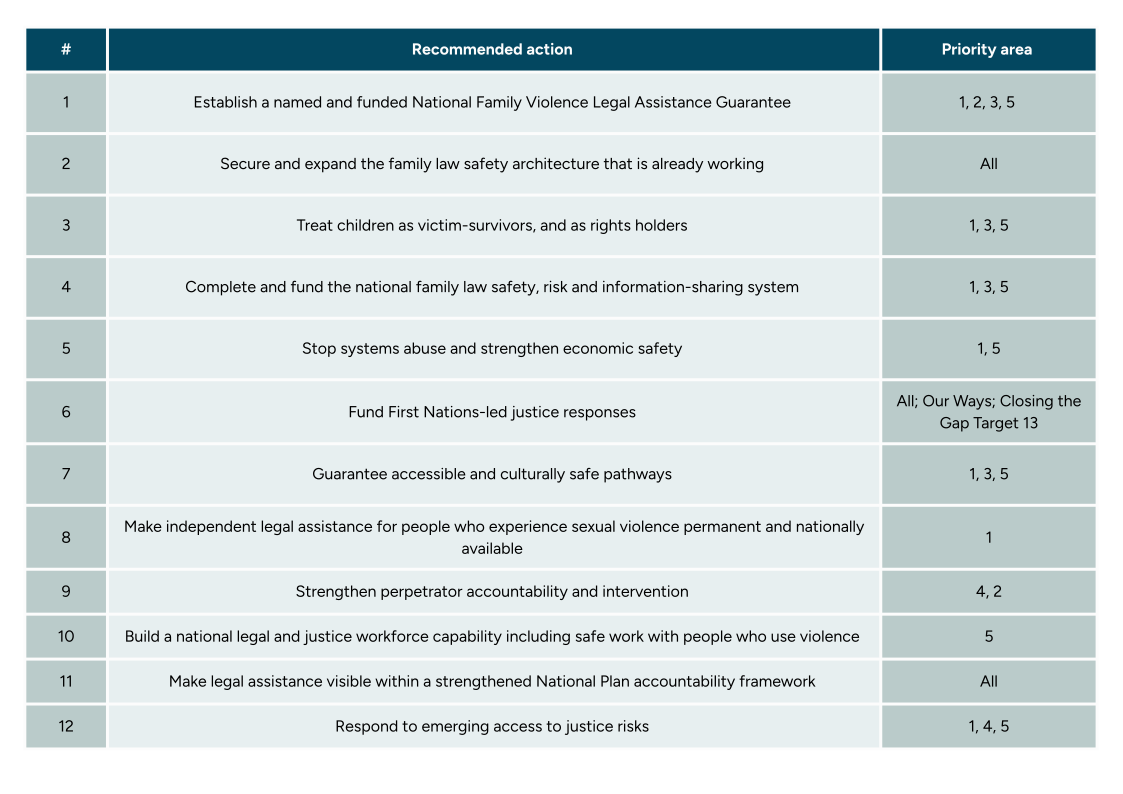
NLA makes 12 recommendations for priority actions, services, and investment under the Second Action Plan, aligned to the Consultation Priority Areas:
- Victim survivors
- Prevention and early intervention
- Children and young people in their own right
- People who use violence
- System integration and workforce
Summary of Recommendations
Recommendation 1: Establish a named and funded National Family Violence Legal Assistance Guarantee
The Second Action Plan should include a dedicated, funded and reportable national action that recognises legal assistance as essential safety infrastructure and establishes a National Family Violence Legal Assistance Guarantee.
The Guarantee should ensure that:
- victim-survivors who cannot safely or reasonably afford private legal services can obtain timely, specialist and culturally safe legal assistance; and
- children whose safety and interests require independent legal representation can receive properly resourced, high-quality assistance.
Legal assistance should be available from the point at which a person is considering separation or seeking protection through to the resolution, enforcement or variation of family violence, parenting, property, child-support and related legal matters. The level and continuity of assistance should reflect legal need, safety risk, complexity and the consequences of proceeding without representation.
Recommendation 2: Secure and expand the family law safety architecture that is already working
Commit governments, working with Legal Aids and service providers, to make proven models including family law services, FASS, Domestic Violence Units (DVUs), HJPs, ICLs, and legally-assisted dispute resolution permanent, nationally accessible and capable of meeting demand.
Recommendation 3: Treat children as victim-survivors, and as rights holders
Recognise children and young people affected by family violence as victim-survivors and rights holders. The Second Action Plan should make the family law system a funded point of intervention for children’s safety, participation and recovery.
Recommendation 4: Complete and fund the national family law safety, risk and information-sharing system
Commit the Australian Government, in partnership with state and territory governments, to complete and sustainably fund a national, safety-by-design system for identifying and responding to family violence risk in family law matters.
Recommendation 5: Stop systems abuse and strengthen economic safety
Require every relevant legal and administrative system to prevent, identify and remedy systems abuse. It should include family law, child support, tax, social security, migration, child protection, complaints and financial systems.
Recommendation 6: Fund First Nations-led justice responses
Governments should give effect to Our Ways - Strong Ways - Our Voices: National Aboriginal and Torres Strait Islander Plan to End Family, Domestic and Sexual Violence 2026-2036 (Our Ways – Strong Ways – Our Voices) through First Nations decision-making authority, long-term, flexible and full-cost investment to Aboriginal and Torres Strait Islander Legal Services (ATSILS), Family Violence Prevention Legal Services (FVPLS) and other Aboriginal community controlled organisations (ACCOs); and require mainstream legal and service systems to implement co-designed institutional reforms.
Recommendation 7: Guarantee accessible and culturally safe pathways
Set enforceable accessibility and cultural safety standards for legal and justice systems and fund the specialist pathways, adjustments and workforce needed to meet them.
Recommendation 8: Make independent legal assistance for people who experience sexual violence permanent and nationally available
The Second Action Plan should make specialist independent legal assistance for people who experience sexual violence a named, funded and reportable national action. Governments should implement the legal assistance recommendations in the Australian Law Reform Commission’s (ALRC) Safe, Informed, Supported report and establish a funded pathway from the current sexual violence legal-service pilots to permanent national coverage.
Recommendation 9: Strengthen perpetrator accountability and intervention
Governments should establish national minimum standards, accreditation, partner-safety requirements and a common outcomes dataset for interventions with people who use violence, while preserving legal advice and procedural fairness.
Recommendation 10: Build a national legal and justice workforce capability including safe work with people who use violence
The Second Action Plan should fund a national family violence capability and accountability framework for legal and justice workforces. The framework should establish nationally consistent, role-specific and assessable capabilities, supported by the supervision, practice systems, workload settings and workforce conditions required to translate learning into safe practice.
Recommendation 11: Make legal assistance visible within a strengthened National Plan accountability framework
The Second Action Plan should strengthen and integrate the National Plan’s existing implementation, monitoring and reporting arrangements and ensure they can answer a fundamental safety question: can victim-survivors and children obtain timely, specialist and culturally safe legal assistance, and are legal and justice systems improving their safety, agency and access to justice?
Recommendation 12: Respond to emerging access to justice risks
The Second Action Plan should recognise AI-enabled and technology-facilitated abuse as an emerging family violence priority and fund legal assistance, digital safety, trusted multilingual legal information, and justice-system capability to detect manipulated evidence and respond to AI-related abuse. It should also support national research on victim-survivors’ use of AI and other online tools for legal help, including impacts on safety, outcomes, court workload and equity.
Alignment with Consultation Priority Areas
NLA’s recommendations align to the consultation priority areas as follows: