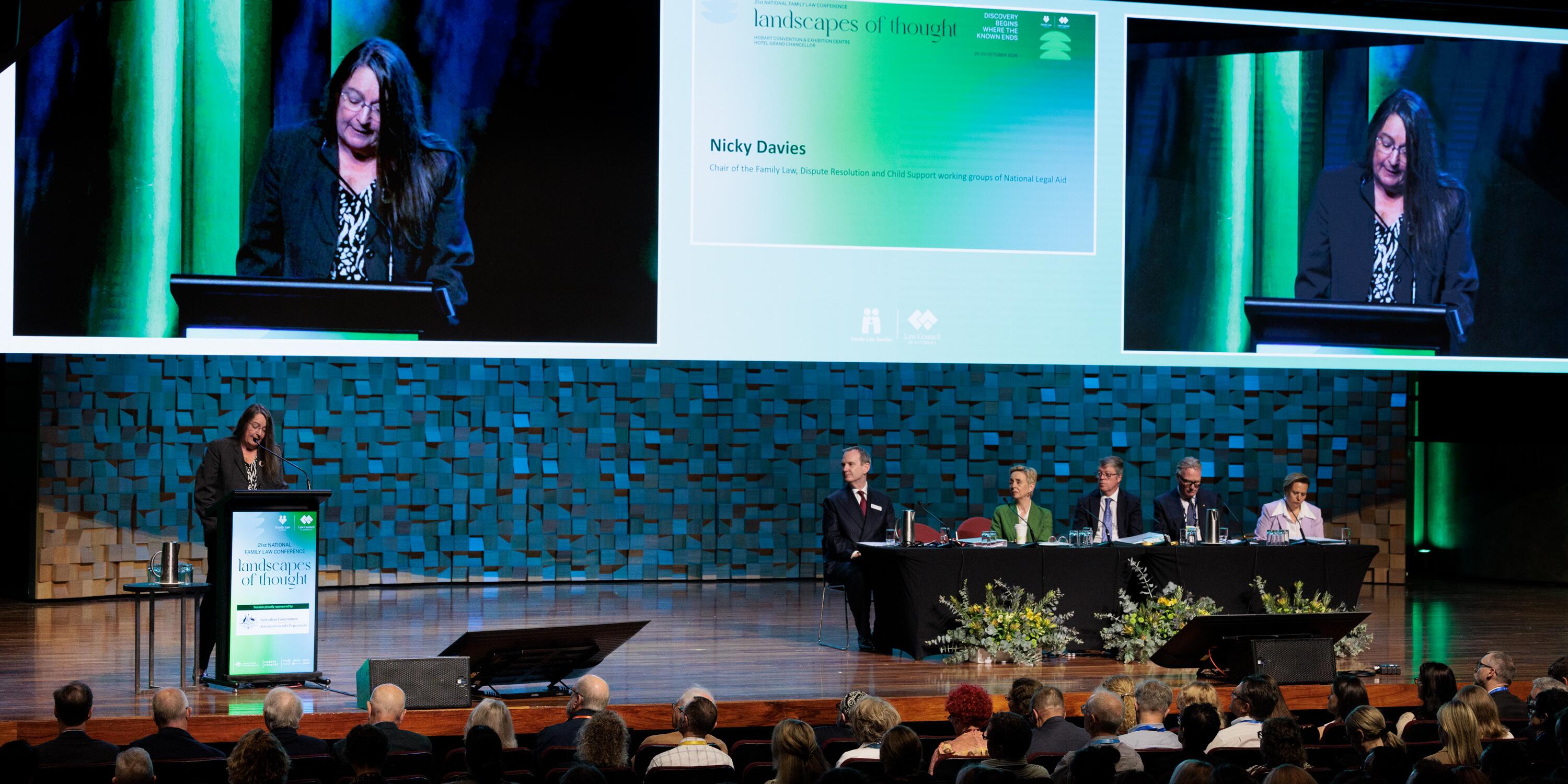
National Legal Aid (NLA) was proud to be represented at the 2026 National Family Law Conference in Hobart.
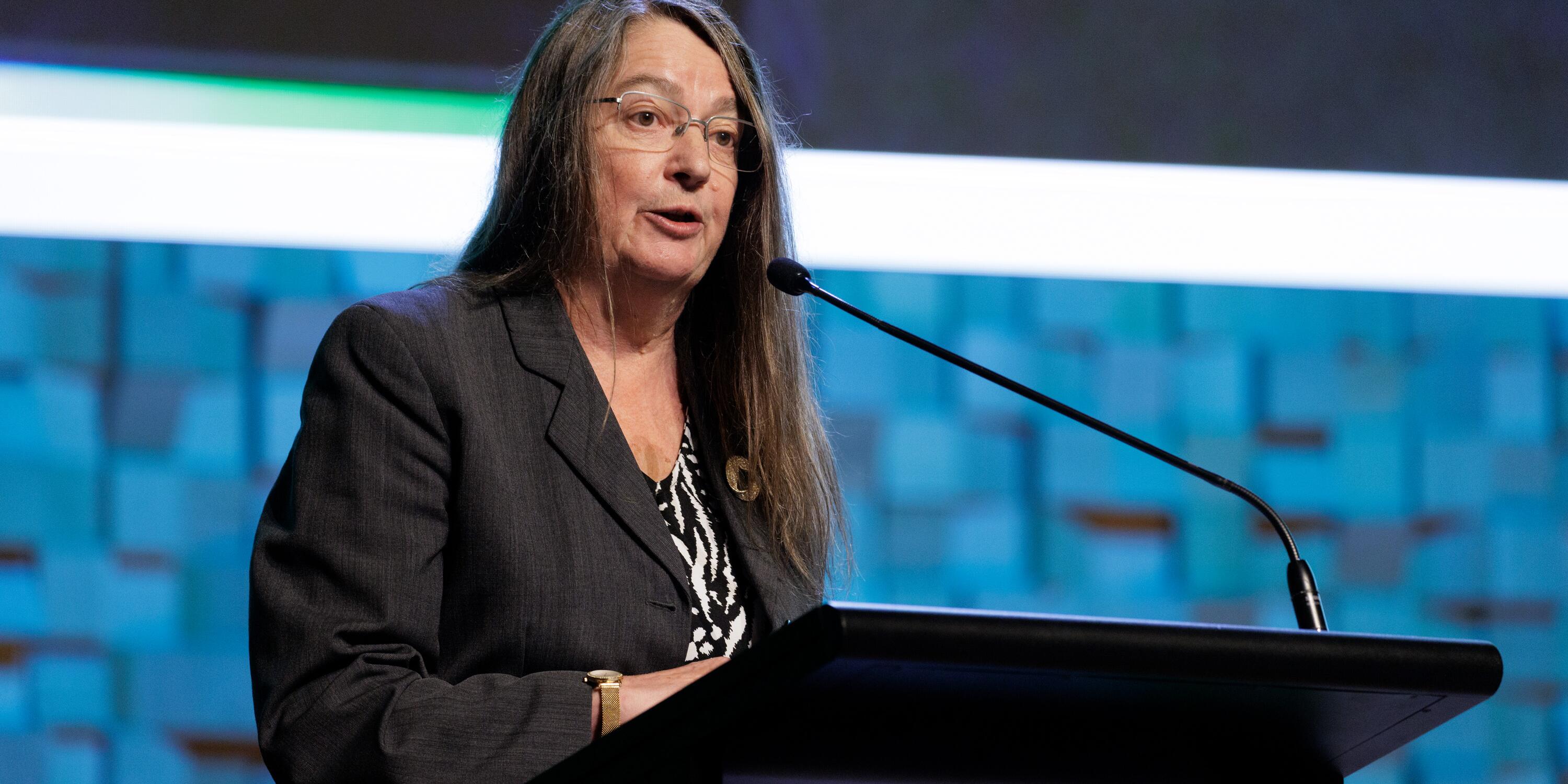
Below is the transcript of a speech given on behalf of NLA by A/CEO Legal Aid Queensland and Chair of NLA Family Law, Dispute Resolution, and Child Support working groups, Nicky Davies, as part of the session entitled, 'State of the Nation'.
I respectfully acknowledge the Traditional Owners of these lands and pay respect to Elders past, present and emerging.
I would like to begin by recognising the breadth of the profession: judicial officers, dispute resolution practitioners, private and Legal Aid lawyers, barristers, community legal centre and women’s legal services practitioners, specialist family violence services, family consultants, First Nations legal services and specialist community support services.
For people facing separation: access to justice is about helping them to understand options, empowering them to make informed decisions about children and finances, resolving disputes safely, and obtaining orders that will work in daily life.
The profession has significant skills in handling emotionally difficult matters while upholding procedural fairness for parties and children.
For families, access to justice is about whether they can make safe, informed decisions
when the consequences will shape the rest of their lives, and importantly those of their
children.Legal Aid Commissions provide end-to-end assistance in family law including information and early legal advice, securing safety of parties and children through domestic and family violence protection orders when necessary, lawyer assisted family dispute resolution, duty lawyers, ongoing parenting and property representation, child support assistance and help when orders need to be varied or enforced. If child welfare authorities are involved with families, legal aid commissions can assist with early legal intervention and ongoing representation in child protection proceedings.
Family law legal help through legal aid commissions and their partners provide significant opportunities for early intervention to secure safer, workable family law outcomes.
In particular, legally assisted family dispute resolution plays an important role in helping families reach safe family law outcomes outside of court, for themselves and children who are impacted by separation and disputes.
Despite the benefits of resolving matters outside of court, sometimes judicial determination will be necessary, particularly where safety depends on it. Legal assistance in these matters is critically important. It is often incredibly difficult for parties to navigate the family law system alone and without appropriate legal assistance.
Important work is undertaken in court registries throughout the country by the Family Advocacy and Support Services which combine legal help with social support at court.
One of the most crucial services provided by legal aid commissions is the national Independent Children’s Lawyer program. I had the immense privilege of spending yesterday at the Sixth National Independent Children’s Lawyers Conference, with over 200 delegates and presenters, including nearly 170 experienced and extraordinarily committed practitioners from private practice and legal aid commissions who undertake the challenging and critical
role of independent children’s lawyers in thousands of cases each year.Another important program administered by the legal aid commissions in family law is the Commonwealth Family Violence Cross-examination of Parties Scheme. Uncertainty around ongoing funding of this scheme is a significant issue for legal aid commissions.
The Australian Government is presently developing the Second Action Plan, of the National Plan to End Violence against Women and Children 2022 - 2032: family law, violence and children’s safety. This is a key opportunity for the Government to recognise and support the role played by the wider family law profession in keeping women and children safe.
Family law is at the centre of Australia’s family violence response. In 2024–25, notices filed with applications for final parenting orders included an allegation of family violence in 86% of matters and an allegation of child abuse or risk of abuse in 77% of cases.
Decisions about parenting, property, child support and enforcement can support safety and recovery for women and children.
Legal processes can also be used to continue coercion after separation. The appropriate legal representation of parties using violence is of fundamental importance as a safeguard against systems abuse, including litigation-facilitated abuse.
There is a need to treat children as victim-survivors and rights holders themselves in the family law system. Their safety concerns and views need appropriate ways to be safely heard, including through properly resourced Independent Children’s Lawyers.
National Legal Aid is undertaking a project to map the experiences of women and children impacted by domestic and family violence, who are involved in the family law system in each State and Territory jurisdiction.
Legal aid commissions have long understood and recognised the importance of domestic and family violence capability in the family law workforce. National Legal Aid has developed ‘Understanding coercive control when providing legal assistance Training’, along with our consortium partners Women’s Legal Services Victoria, First Nations Advocates Against Family Violence and Women’s Legal Services Australia, who collaborated in the design and delivery of the training. The training was created with funding from the Australian Government.
It is free online training about recognising and responding to coercive and controlling behaviours across a range of legal issues. It is aligned with the National Principles to Address Coercive Control. The training includes a foundational course for all legal practitioners and a family law-specific course. Both count towards continuing professional development requirements nationwide.
Legal assistance is critical to safe family law outcomes for women and children. The Second Action Plan is an opportunity to ensure that legal help is available for women to safely separate from a violent partner, and to ensure that children are recognised as victim survivors in their own right in the family law system, have their voices heard, and their best interests represented.
I would like on behalf of National Legal Aid to thank all family law private practitioners who take grants of legal aid, including those who serve regional communities, and those who act as Independent Children’s Lawyers.
I acknowledge the challenges being experienced by the private profession, despite their strong commitment to the work. I note that unremunerated work was identified by practitioners as the key challenge in the Private Practitioner Census commissioned by National Legal Aid in 2024. 85% of practitioners identified this as an issue. National Legal Aid is acutely aware of the increasing complexity of legal aid family law matters.
The need for legal aid grants and Independent Children’s Lawyer fees to reflect the work required is recognised and acknowledged by National Legal Aid. We continue to work with government and the courts to try and address these issues to help ensure a vibrant network of partner lawyers to undertake legally assisted work into the future.
Legal aid commissions are committed to engaging with private practitioners and trying to reduce the administrative burden on lawyers in grants of legal aid processes. However, National Legal Aid acknowledges that increased funding is needed to address the sustainability of the mixed model of service delivery in legal aid grants representation.
The family law workforce is a core frontline service in Australia’s family violence response. I would ask that you all bring your frontline professional expertise and experience to the conference discussions. For example, raise what you see where clients cannot find representation, or where children’s concerns are missed, or where processes allow abuse to continue.
National Legal Aid is committed to working with private practitioners, the family law courts, governments, Aboriginal Community Controlled Organisations, the legal assistance sector, specialist family violence services, and people with lived experience to continue to improve the family law system.
Family law professionals are critical to access to justice during one of the most difficult times a person can face in their life. Family lawyers help turn legal rights into reality and practical safety. The Second Action Plan is an opportunity to appropriately recognise the essential work of the family law profession and ensure vulnerable people – including children – can access help when they need it most.
The family law profession sees the difference that skilled legal help makes for people every day. Our shared task going forward is to ensure that help is available during one of the most challenging life experiences a person can face, and particularly when safety depends on it. Thank you.